
Veejay Floresca, Project Runway’s First Trans Winner, Is Designing a Legacy Beyond the Runway
From Manila to New York, Veejay Floresca waited twenty-one years to become Project Runway's first trans winner.
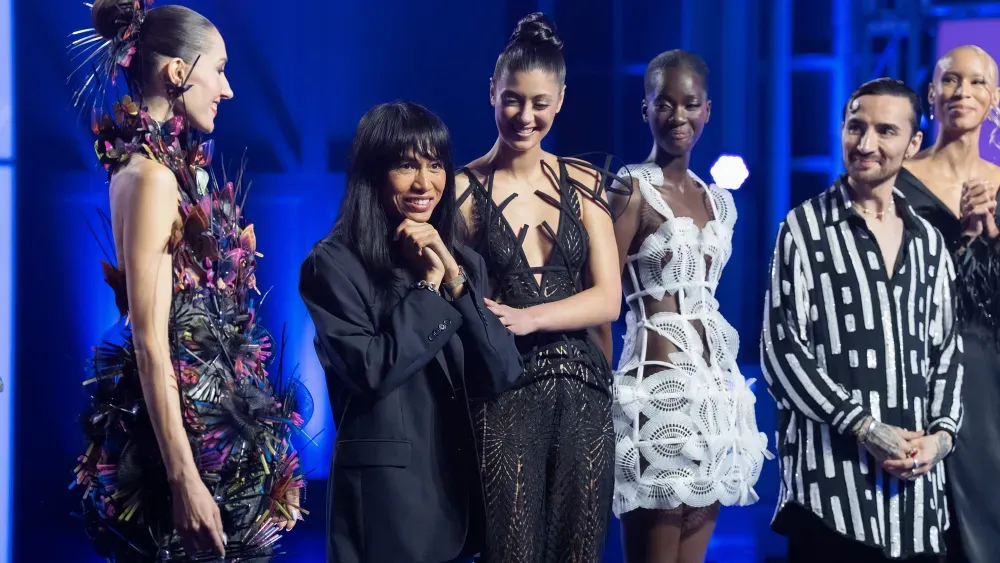
The dress was made entirely of badminton shuttlecocks: hundreds of white feathered cones sculpted into a dramatic silhouette that moved like armor. When Veejay Floresca sent it down the runway during Project Runway Season 21's unconventional materials challenge, it became one of the season's most iconic moments. But the real victory would come later. After twenty-one auditions spanning two decades and hearing "no" twenty times, Floresca finally heard her name called as the winner of Project Runway. She became the first transgender designer to claim the title in the show's history.
“I came here with the goal to be the first trans woman to win this competition,” she said in her finale confessional. “I think that will really inspire my community that you can actually reach your dreams by being who you are.”
Floresca has been watching Project Runway since she was, in her words, “a little gay boy in the Philippines.” She remembers the very first episode in 2004, when Austin Scarlett stunned the judges with a dress made out of corn husks. On that day, she made a promise to herself: one day, she would step onto that stage and win.
She kept applying season after season, hearing "no" each time. Twenty-one attempts for Season 21—a cosmic alignment that feels almost too perfect to be true, yet speaks to the patience required to build a fashion career. By the time she finally heard "yes," Floresca had already built a name as an eveningwear and bridal designer, placed runner-up on the first spin-off season of Project Runway Philippines, and competed on Hulu's "Dress My Tour." Each rejection had been a sharpening stone, pushing her to refine her voice until she was ready not just to compete, but to win.
“I believe in destiny—and I truly feel this was the right time for me,” she told me. “I patiently waited for this moment, and now it’s a dream come true. I’m using this opportunity to grow my business and inspire others to stay resilient and never give up on their dreams.” And destiny had a few more surprises up her sleeve as Season 21 marked the long-awaited return of Heidi Klum as host, a full-circle moment for Floresca, who had fallen in love with the show during its earliest years.
Her finale collection carried a deeply personal inspiration: “Terminator 2: Judgment Day”, a film she used to watch with her late father. After his death in 2001, Floresca’s family struggled financially, and she has spoken about how fashion became both her survival and her calling.
“Winning Project Runway would give me the money to take care of my family, and to give them a better life,” she shared on the show. At the finale, where her mother and aunt attended, Floresca told her mother, “No matter what happens, I’m going to make you proud.” That night, she proved that the twenty-one auditions she did were worth it. She had become the show’s first transgender winner.
Throughout the season, Floresca flexed daring creativity and meticulous craftsmanship that would make luxury brands jealous. Beyond the shuttlecock dress, she consistently pushed boundaries with ingenuity. "I think it really showed my innovation and my creativity," she said. "Innovation is at the heart of my design aesthetic, so I'm always experimenting with new techniques and materials. I even created a runway-inspired dress for NYFW. I love bringing fresh and unexpected ideas to every collection."
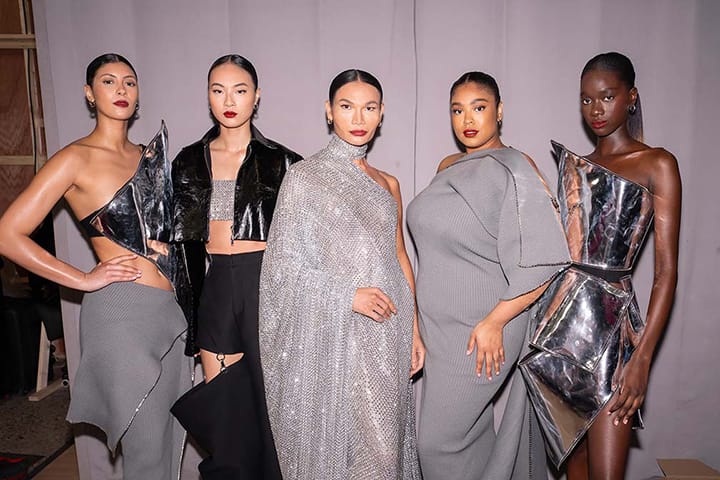
For Floresca, design is inseparable from inclusivity. Her atelier operates on the principle that fashion is for everyone regardless of body type, gender, or background. "My brand stands for inclusivity and diversity, and that starts with who I work with, from clients to collaborators," she told me. "Everyone is beautiful and unique, and my mission is to celebrate that through fashion."
That commitment shaped her finale show, where she cast Mimi Tao, a trans model who had previously walked on Project Runway. It was a decision that wove together the legacy of trans representation on the runway, situating her own win within a larger lineage. Her most recent New York Fashion Week capsule reflected the same values: unlike the purely conceptual pieces that often dominate fashion week, her collection was designed to be ready-to-wear and versatile. "The goal was to create a capsule collection for my clients. Something wearable and versatile, not just conceptual," she explained. "It's a reflection of how I want my brand to grow: creating pieces that are thoughtful, empowering, and designed for real, diverse women."
This inclusivity guided her most recent New York Fashion Week capsule, too. Unlike the purely conceptual pieces that often dominate fashion week, her collection was designed to be ready-to-wear and versatile, tailored to the needs of real clients. “The goal was to create a capsule collection for my clients. Something wearable and versatile, not just conceptual,” she explained. “It’s a reflection of how I want my brand to grow: creating pieces that are thoughtful, empowering, and designed for real, diverse women.”
Beyond the runway, Floresca is focused on building a legacy that uplifts others. Through the Veejay Floresca Foundation in the Philippines, she supports aspiring designers and LGBTQ+ creatives. “Fashion has always been a safe space for us,” she told me. “Through the foundation, I want to inspire and uplift the LGBTQ+ community by encouraging young creatives to embrace their uniqueness and pursue their dreams. I want them to know their voices and talents matter.”
Her victory comes with tangible resources: a $200,000 cash prize, mentorship with the Council of Fashion Designers of America, and a spread in Elle magazine. These opportunities position her to translate reality television success into a long-term fashion brand. Critics already see her as a designer with staying power. “What she presented was so cohesive,” Them’s Michael Cuby said of her finale collection. “It had such a distinct point of view, and it’s speaking to the future. That’s what I want to see from fashion.”
Floresca herself has a clear vision of that future. Zendaya tops her dream client list. "I already actually have a design for her, I'm just waiting for Law Roach to call," she laughed. In our conversation, she also added Olivia Rodrigo. "She's half Filipino and I'm a huge fan of hers." Dressing Heidi Klum and Nina Garcia would be another full-circle moment, a way of giving back to the women who had judged her work each week.
But her biggest ambition is to achieve the kind of commercial success that has eluded most Project Runway winners, except for Christian Siriano, who built a multi-million dollar empire. Floresca sees herself following that same path. "If there's Kelly Clarkson and Carrie Underwood of American Idol, there's Veejay Floresca and Christian Siriano of Project Runway," she said. "That's the goal, and that's the reason why I joined. I really want to grow the business and to have a brand. So I hope–not I hope–I will make that happen."
In the current political climate, where simply being trans puts a target on your back, Floresca's win matters beyond fashion. She knows her glass ceiling-breaking victory isn't just for her. "It's a big celebration for my community," she said. "It's a big hope to people who feel that they can achieve something because they're trans or because they're gay." For her, the season's queer top three—Jesus Estrada from Mexico, Ethan Mundt from the U.S., and herself from the Philippines—was proof that fashion is evolving, even as queer rights are being challenged globally.
From her childhood in the Philippines, watching Project Runway with wide eyes, to a confetti-filled stage in New York, Floresca's journey has been about more than just clothes. It is about persistence in the face of multiple rejections, familial memory woven into fabric, and the radical act of designing for every body. It is about honoring her father, supporting her mother, lifting her community, and imagining a future where fashion truly belongs to everyone.
And somewhere, waiting in a sketchbook, is a design for Zendaya. She's just waiting for that call from Law Roach.